Table of Contents
- Introduction
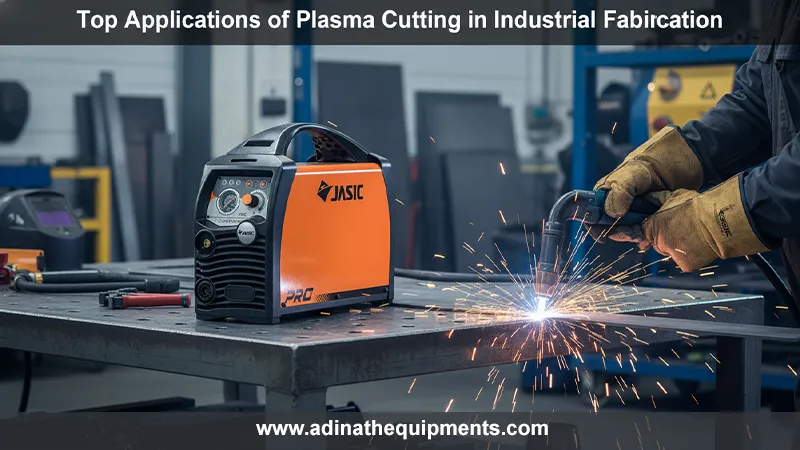
The development of industrial fabrication has increased very fast in the past several decades with the need for precision, speed and cost efficiency. Plasma Cutting is one of the numerous technologies that have influenced this change and has proven to be one of the most acceptable and efficient tools of cutting electrically conductive materials. Starting with heavy engineering to fine metal detailing, this technology is decisive in the modern manufacturing processes.
The industries we closely deal with at Adinath Equipments are those that rely on the advanced cutting solutions to ensure that they are productive and of good quality. This elaborated tutorial examines the current most significant uses of the Industrial Plasma Cutting in the industry production process, how it can be used to promote accuracy, scalability, and operational efficiency in industries.
Understanding Plasma Cutting in Industrial Fabrication
Plasma Cutting is a thermal cutting method that involves a jet of ionized gas of high velocity in cutting conductive metals which includes steel, stainless steel, aluminum, copper, and brass. It is done by applying an electric arc between an electrode and a workpiece converting gas into the plasma that can attain extremely high temperatures.
Industrial Plasma Cutting systems in the industrial setting are also built with continuous running capability, greater amperage, and CNC automation. This allows them to be used in both small fabrication workshops and production facilities of large scale. Plasma cutting is more flexible in cutting a wide range of materials with varying thicknesses, has higher cutting speeds, and the cut edges are cleaner than with traditional methods of cutting.
Role of Plasma Cutting in Modern Industrial Fabrication
Industrial fabrication refers to the process of bending, cutting, and welding metal materials to complete or semi-complete products. The quality of welding, structural integrity and performance of the final product all depend on accuracy at the cutting stage. Plasma Cutting has helped fabricators in that it provides a consistent output despite the stressful production timings.
When using Industrial Plasma Cutting, manufacturers have more control over tolerances, less rework, and also improved use of materials. These advantages have made plasma systems an intrinsic component in fabrication lines of industries like construction, automotive, power generation, and a heavy machinery manufacturing industry.
Key Applications of Plasma Cutting in Industrial Fabrication
Structural Steel Fabrication
Structural steel fabrication is one of the most evident uses of Plasma Cutting. The constructions and plateworks of buildings, bridges, and infrastructure projects have beams, columns, plates, and brackets which must be cut accurately to allow proper alignment and division of loads. Plasma cutting is effective in cutting thick parts of steel and it saves time in production without affecting precision. The Industrial Plasma Cutting machines are used by fabricators to shape profiles, bolt holes and custom forms that are required by modern architectural designs. Repetitive production that is necessary in large infrastructure projects is also supported by this technology.
Automotive and Transportation Industry
Metal fabrication is used in the automotive and transportation industries in the form of chassis, frames, panels and brackets. Plasma Cutting allows the manufacturers to handle mild steel and aluminum parts at high speed and accuracy. Industrial Plasma Cutting systems combined with CNC tables can be used in automotive fabrication units to provide high levels of repeatability. This enhances uniformity of components and lean manufacturing. Plasma cutting is very applicable to the automobile parts of the body and structural steel because of its capability to cut both thin and medium-thickness metals.
Heavy Machinery and Equipment Manufacturing
Components of heavy machinery are usually thick metal plates and complicated shapes. Plasma Cutting is the method that is effective in cutting such materials and leaving acceptable edge quality that can be used in later welding or machining operations. Industrial Plasma Cutting is being applied in the manufacture of earthmoving equipment, agricultural machinery, and industrial tools in order to simplify fabrication. The technology also facilitates faster turnaround time and it easily suits customized designs that are popular in manufacturing heavy equipment.
Shipbuilding and Marine Fabrication
Ship construction involves cutting steel plates (steel hulls, steel decks and steel internal structures) in accurate shapes. Plasma Cutting is also crucial to this industry because it is able to cut heavy materials effectively. Using the Industrial Plasma Cutting process, shipyards are able to preserve dimensional accuracy on huge parts. This enhances alignment of the assembly and minimizes distortion in the welding process of the assembly which is of paramount importance to the marine safety and product life.
Power Generation and Energy Sector
Thermal, hydro, and renewable power plants are in need of strong metals and compounds. Plasma Cutting aids in the manufacturing of frames and enclosures, ducts, and support structures of power generation facilities. Industrial Plasma Cutting is used in this industry, to assist manufacturers in achieving high quality standards in production at large scale capacity. Technology promotes uniform outcomes of various grades of materials applied in energy infrastructure.
Metal Furniture and Architectural Fabrication
Metal panels used to decorate the building, staircases, railings, and furniture items usually entail complex designs. Plasma Cutting enables the fabricators to obtain complicated shapes having a smooth outline. Industrial Plasma Cutting systems in conjunction with CNC controls are useful to architectural fabricators to convert digital designs to precise metal products. This application is a practicality-meets-beauty application, which promotes current architectural movements.
Manufacturing of Industrial Storage and Handling Systems
The racks, pallets, bins, and storage systems utilized in warehouses and factories have to be cut with great accuracy in order to be strong and compatible. Plasma Cutting eases the manufacturing of such components as it provides uniformity of the edges and dimensional precision. Through the Industrial Plasma Cutting, the manufacturers can scale production effectively maintaining consistency in each batch, which is critical to the industrial storage solutions.
Fabrication of Oil and Gas Industry
Oil and gas industry requires tough metal parts that can withstand the hard operating conditions. Pipelines, flanges, structural supports and pressure vessel components are made by means of Plasma Cutting. Industrial Plasma Cutting is used to reinforce heavy fabrication in this application. Technology processes heavy materials that are usually applied in oil and gas infrastructure thereby facilitating the safety and efficiency of project implementation.
Why Choose Adinath Equipments for Plasma Cutting Solutions
Adinath Equipments has gained a good reputation in providing good plasma cutting solutions that are in tandem with actual industrial needs. We are still interested in learning about the problem of fabrication and offering equipment that helps in ensuring productivity, accuracy, and long-term skills. At Adinath Equipments, the clients are getting industry-based guidance; reliable systems; and reliable support. We respond to the demands of the contemporary fabrics and, therefore, Adinath Equipments can serve as an ally to organizations that are interested in having effective and performance-oriented plasma cutting systems.
Conclusion
The speed, flexibility and precision of Plasma Cutting made it one of the pillars of industrial fabrication. Its use in structural steel and automotive manufacturing has not ended and it is increasingly used in shipbuilding and energy infrastructure. The Plasma Cutting system of industries ensures stability in quality, production and flexibility in various fabrication spaces. Plasma cutting is a viable and proven solution as industries require more productivity and accuracy in the industry. Adinath Equipments has been on the forefront to serve this evolution by providing dependable plasma cutting technologies to the industrial fabrication requirements.
Looking to explore advanced plasma cutting solutions. Call +91 98791 56589 or email info@adinathequipments.com.
Key Takeaways
- Plasma Cutting is constructed on actual industrial pressure: Thick metal. Tight timelines. Complex shapes. Plasma Cutting does not reduce speed of production and does not reduce accuracy of all three.
- It corresponds to nearly all sectors of fabrics: Industrial Plasma Cutting can be easily adapted to structural steel and automotive parts, industry, shipbuilding, and energy works. One technology. Many applications.
- Quickness is a Direct Proportionality to Productivity: Reduction in the speed of cuts implies reduction in the number of bottlenecks. Less waiting between stages. Such speed advantage saves time, effort, and the general costs of fabrication quietly.
- The Game of CNC Integration: Plasma cutting provides accuracy which is reproducible when combined with CNC automation. Same cut. Same quality. Batch after batch. That consistency matters.
- Clean Cuts Minimize Downstream Issues: Improved quality of edges will result in ease of welding, reduced grinding, and reduced rework. In fabrication, the initial clean cutting is a preventive measure of bigger problems in the future.
Frequently Asked Questions (FAQs)
Appropriate electrically conductive materials like mild steel, stainless steel, aluminum, copper and brass conductors can be cut using plasma cutting.
Yes, the industrial plasma cutting systems can cut medium and thick materials effectively, but it is dependent on power capacity and configuration.
The speed of cutting with plasma is higher in cutting thicker materials and is typically less expensive when cutting heavy fabrics.
Yes, most industrial plasma cutting systems are linked to CNC automation to lead to accuracy, repeatability, as well as greater productivity.
Plasma cutting is greatly beneficial to such industries as construction, automotive, shipbuilding, heavy machinery, and energy sectors.